

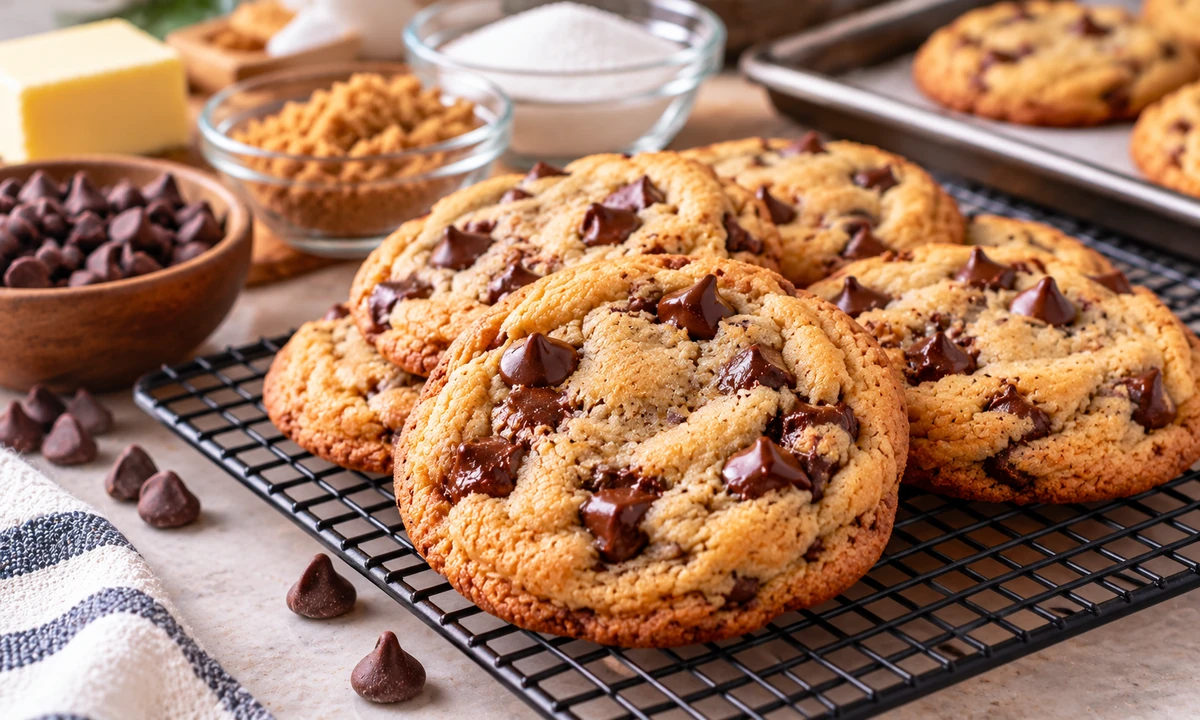
A classic chocolate chip cookie should have lightly golden edges, a soft center, and chocolate in every bite. This recipe sticks to everyday ingredients and focuses on the small details that decide the result: softened butter, accurately measured flour, gentle mixing, and pulling the cookies out of the oven at the right moment.
The recipe makes about 24 cookies. Bake the dough right away for a classic cookie, or chill it first for a thicker one. Chocolate, nuts, and other add-ins are easy to change without touching the base recipe.
Recipe at a Glance
- Yield: about 24 cookies (a scoop of roughly 3 tablespoons of dough each)
- Prep time: about 15 minutes
- Chill time: optional, 30 minutes for thicker cookies
- Bake time: 10–12 minutes at 350°F (175°C)
- Cooling: 5 minutes on the baking sheet, then on a wire rack
Why This Recipe Works
A chocolate chip cookie is a balance of a few ingredients. Brown sugar adds moisture and chew, while granulated sugar helps the edges brown and crisp. Butter brings richness, eggs bind the dough, and flour gives the cookie its structure.
Flour is the ingredient most people get wrong. Too much makes cookies dense and dry, so measure it carefully. Baking time matters just as much: cookies keep setting after they leave the oven, so the centers should still look slightly soft when you take them out.
Ingredients
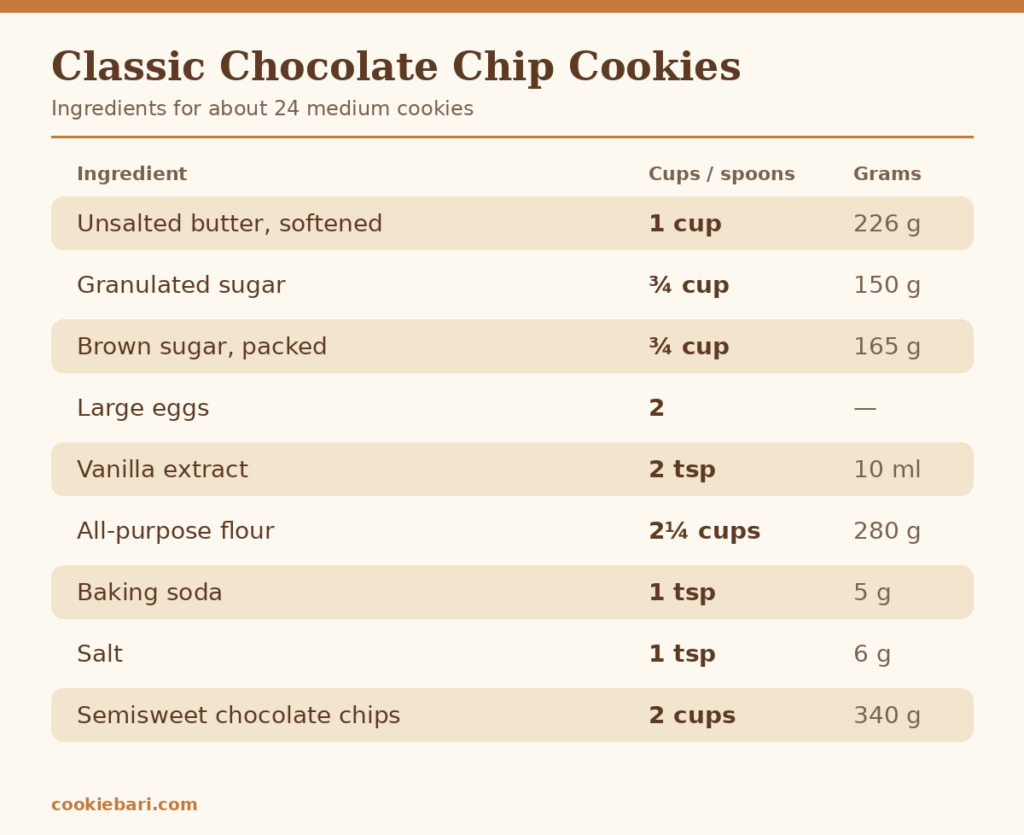
Ingredient measurements at a glance.
- 1 cup (226 g) unsalted butter, softened
- ¾ cup (150 g) granulated sugar
- ¾ cup (165 g) packed brown sugar
- 2 large eggs
- 2 teaspoons vanilla extract
- 2¼ cups (about 280 g) all-purpose flour
- 1 teaspoon baking soda
- 1 teaspoon salt
- 2 cups (340 g) semisweet chocolate chips
Ingredient Notes
Butter: Use unsalted butter that is softened but not melted. It should dent easily when pressed with a finger while still holding its shape. Melted butter makes the dough spread more.
Sugars: Brown sugar gives a softer, chewier cookie. Granulated sugar adds crisp edges and helps with browning.
Flour: King Arthur Baking points out that a cup of all-purpose flour can weigh anywhere from about 120 grams (fluffed, spooned, and leveled) to as much as 160 grams (packed), which is why weighing is the most reliable method. Their guide to measuring flour the right way explains both methods.
Chocolate: Semisweet chips give the classic flavor. Chopped chocolate or chunks work too and melt into larger pools.
How to Make Classic Chocolate Chip Cookies
1. Prepare the Oven and Baking Sheets
Preheat the oven to 350°F (175°C) and line your baking sheets with parchment paper. If you don’t have parchment, grease the sheet very lightly, since too much grease changes how the cookies spread. Let the oven fully reach temperature before the cookies go in.
2. Cream the Butter and Sugars
Beat the softened butter, granulated sugar, and brown sugar in a large bowl until smooth and creamy. There is no need to beat it for a long time. Once the butter and sugars are well combined, move on.
3. Add the Eggs and Vanilla
Beat in the eggs one at a time, then add the vanilla. Scrape the sides and bottom of the bowl so everything is evenly mixed.
4. Mix the Dry Ingredients
In a separate bowl, whisk the flour, baking soda, and salt. This spreads the baking soda and salt evenly so no cookie gets too much of either.
5. Make the Dough
Add the dry ingredients to the butter mixture a little at a time. Mix on low speed or stir by hand until the flour has almost disappeared, then stop. The dough should be thick and soft.
6. Fold in the Chocolate Chips
Fold in the chocolate chips with a wooden spoon or spatula until they are spread evenly through the dough. You can swap some or all of the chips for chopped chocolate if you like bigger pockets of melted chocolate.
7. Portion the Dough
Use a cookie scoop or large spoon to portion the dough into equal pieces, and place them on the baking sheet about 2 inches apart. Equal sizes bake at the same rate.
For thicker cookies: chill the portioned dough for at least 30 minutes before baking. For a recipe built around thickness, see our thick chocolate chip cookies.
8. Bake
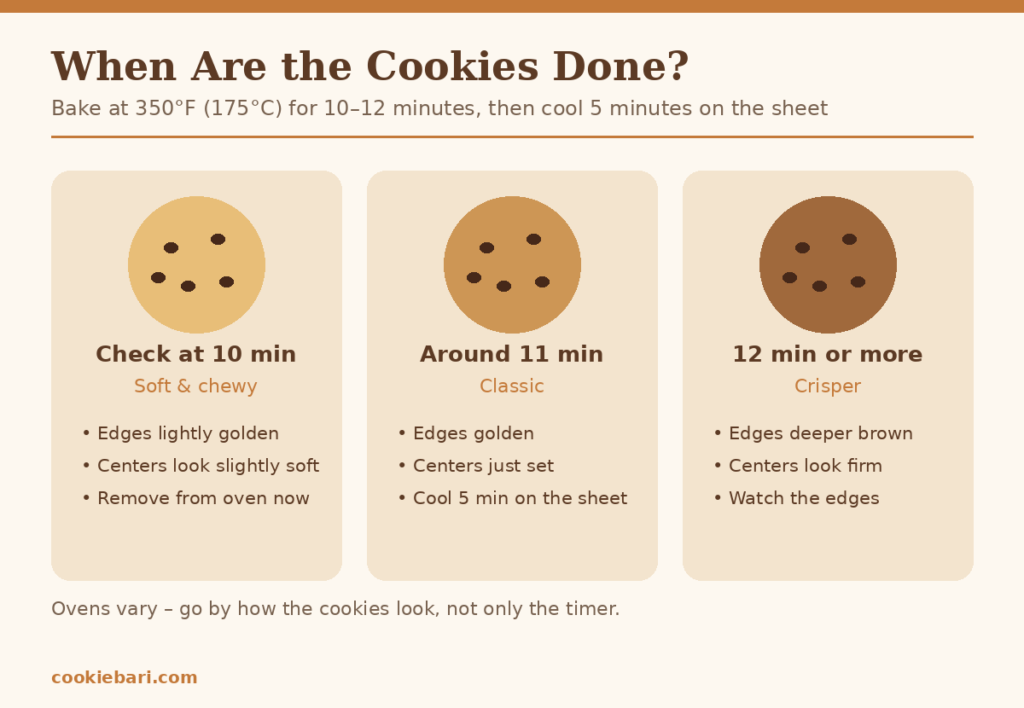
Bake for 10–12 minutes. The edges should be lightly golden and the centers should still look slightly soft. Start checking around the 10-minute mark if you want softer cookies. Ovens and cookie sizes vary, so trust how the cookies look more than the timer.
9. Cool
Leave the cookies on the baking sheet for about 5 minutes so they can firm up enough to move, then transfer them to a wire rack.
How to Tell When They Are Done
Look at the edges and the center, not just the clock. The edges should be set and lightly golden. The center can still look a little soft or slightly underdone. The cookies finish setting from the heat of the baking sheet, so waiting until the centers look completely firm in the oven usually gives you dry, hard cookies once they cool.
Use the look of the edges and centers, not only the timer.
How to Get Soft and Chewy Cookies
- Measure the flour carefully. Weigh it if you can. With measuring cups, spoon the flour into the cup and level it off instead of scooping and packing it down.
- Use softened, not melted, butter. It should be soft enough to mix easily but not liquid.
- Do not overbake. Take the cookies out while the centers still look slightly soft.
Should You Chill the Dough?
Chilling is optional. If you want thicker cookies that spread less, chill the portioned dough for at least 30 minutes. As the butter firms up, it melts more slowly in the oven. If you make the dough several hours ahead, cover it and keep it in the refrigerator. Very cold dough may need a few minutes at room temperature before it is easy to scoop.
Common Problems and Fixes
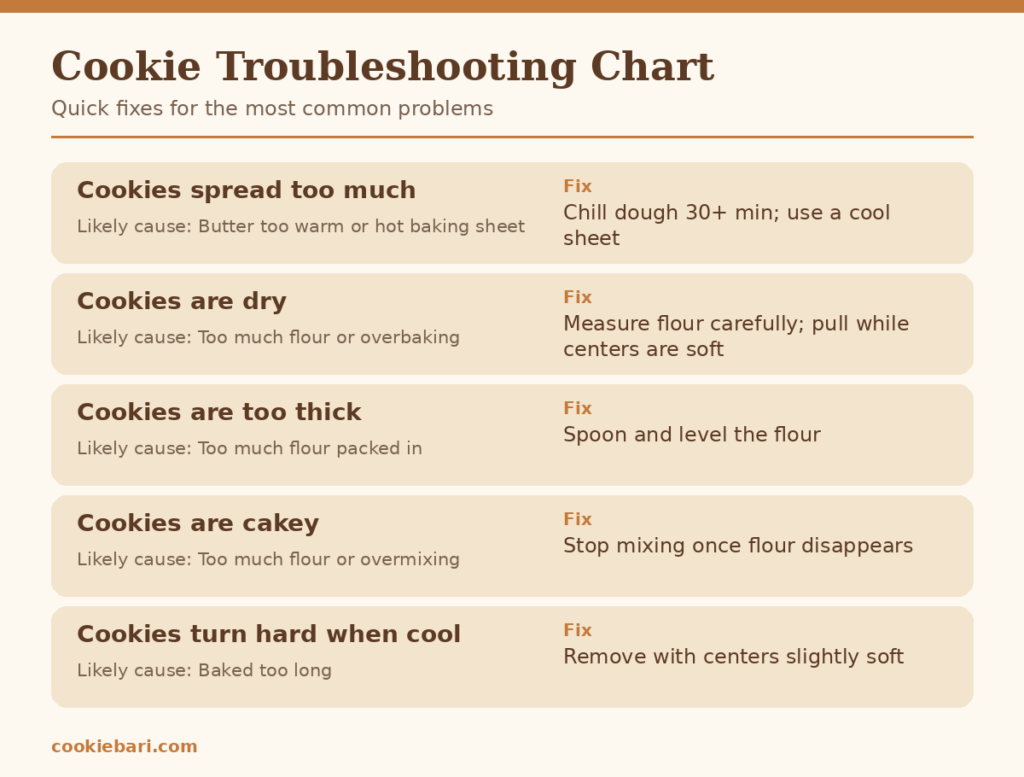
| Problem | Likely cause | Fix |
| Cookies spread too much | Butter too warm, too little flour, or a hot baking sheet | Chill the dough for 30 minutes and use a cool baking sheet for each batch |
| Cookies are dry | Too much flour or overbaking | Measure flour carefully and remove the cookies while the centers still look soft |
| Cookies are too thick | Too much flour, which stiffens the dough | Measure accurately. Chill the dough only if you want a thick cookie on purpose |
| Cookies are cakey | Too much flour or too much mixing | Measure accurately and stop mixing once the flour is incorporated |
| Cookies turn hard after cooling | Baked too long | Pull them earlier. They keep setting on the hot sheet |
Quick fixes for the most common cookie problems.
Variations
- Chocolate chunk: replace some or all of the chips with chopped chocolate for larger pockets of melted chocolate.
- Walnut or pecan: fold chopped nuts into the dough before portioning.
- Dark or milk chocolate: dark chocolate gives a deeper, less sweet flavor, and milk chocolate a sweeter, creamier one.
- Salted: sprinkle a little flaky salt over the cookies just before or right after baking.
- Brown butter: for a toasted, nutty flavor, try our brown butter chocolate chip cookies instead of changing the butter here.
- Extra chocolate: our double chocolate chip cookies add cocoa to the dough.
- Smaller cookies: use less dough per cookie and start checking earlier, or try our mini chocolate chip cookies.
- Just a few cookies: our small-batch cookies are made for a smaller craving.
- No brown sugar: see our chocolate chip cookies without brown sugar, which bake up with lighter color and crisper edges.
- Dairy-free: do not simply swap the butter here. Use a recipe designed for it, such as our soft and chewy dairy-free chocolate chip cookies.
For Crispier Cookies
If you prefer a crisper cookie, bake a minute or two longer and let the cookies cool completely before eating. Watch the edges closely in the last minutes, because the step from lightly golden to overbrowned happens quickly.
How to Store Chocolate Chip Cookies
Let the cookies cool completely, then keep them in an airtight container at room temperature. A sealed container slows moisture loss, so the cookies stay soft longer. If you warm one before eating, be careful, because melted chocolate can get very hot.
Can You Freeze the Dough?
Yes. Place scooped portions of dough on a tray and freeze until firm, then move them to an airtight freezer bag or container. Bake the frozen portions on a lined baking sheet. They may need a little extra time, so watch the edges and centers. Freezing portions also means you can bake just a few cookies at a time.
Tips for Consistent Cookies
- Use softened butter, not melted.
- Measure flour by weight or with the spoon-and-level method.
- Keep portions the same size and leave room between them.
- Stop mixing once the flour is incorporated.
- Chill the dough when you want thicker cookies.
- Use a cool baking sheet for each batch.
- Watch the cookies in the last minutes of baking.
Frequently Asked Questions
Can I use salted butter?
Yes. Reduce the added salt in the recipe so the overall saltiness stays similar.
Can I make smaller cookies?
Yes. Use less dough per cookie and shorten the baking time. Small cookies finish quickly, so start checking earlier.
How do I keep chocolate chip cookies soft?
Do not overbake them, and let them cool completely before sealing them in an airtight container.
Can I make the dough ahead of time?
Yes. Cover the dough and refrigerate it. For longer storage, portion it and freeze the portions.
Can I make a half batch?
Yes. Cut every ingredient in half. Smaller batches can bake a little differently, so go by how the cookies look rather than following the full-batch time exactly. For a much smaller batch, see our small-batch cookies.
Food Safety
Do not eat raw cookie dough. Flour is usually a raw food, and the grain it is made from can carry bacteria such as Salmonella and E. coli. Raw eggs can carry bacteria too. The FDA explains this in its guide to handling flour safely, and the CDC covers the risks in its page on raw flour and dough. Baking is what makes the dough safe to eat.
Final Notes
This classic chocolate chip cookie recipe keeps the process simple and focuses on what matters most for texture: softened butter, carefully measured flour, gentle mixing, and watching the cookies in the final minutes. For soft and chewy cookies, take them out while the centers still look slightly underdone. For a firmer, crisper cookie, give them a little more time in the oven.