

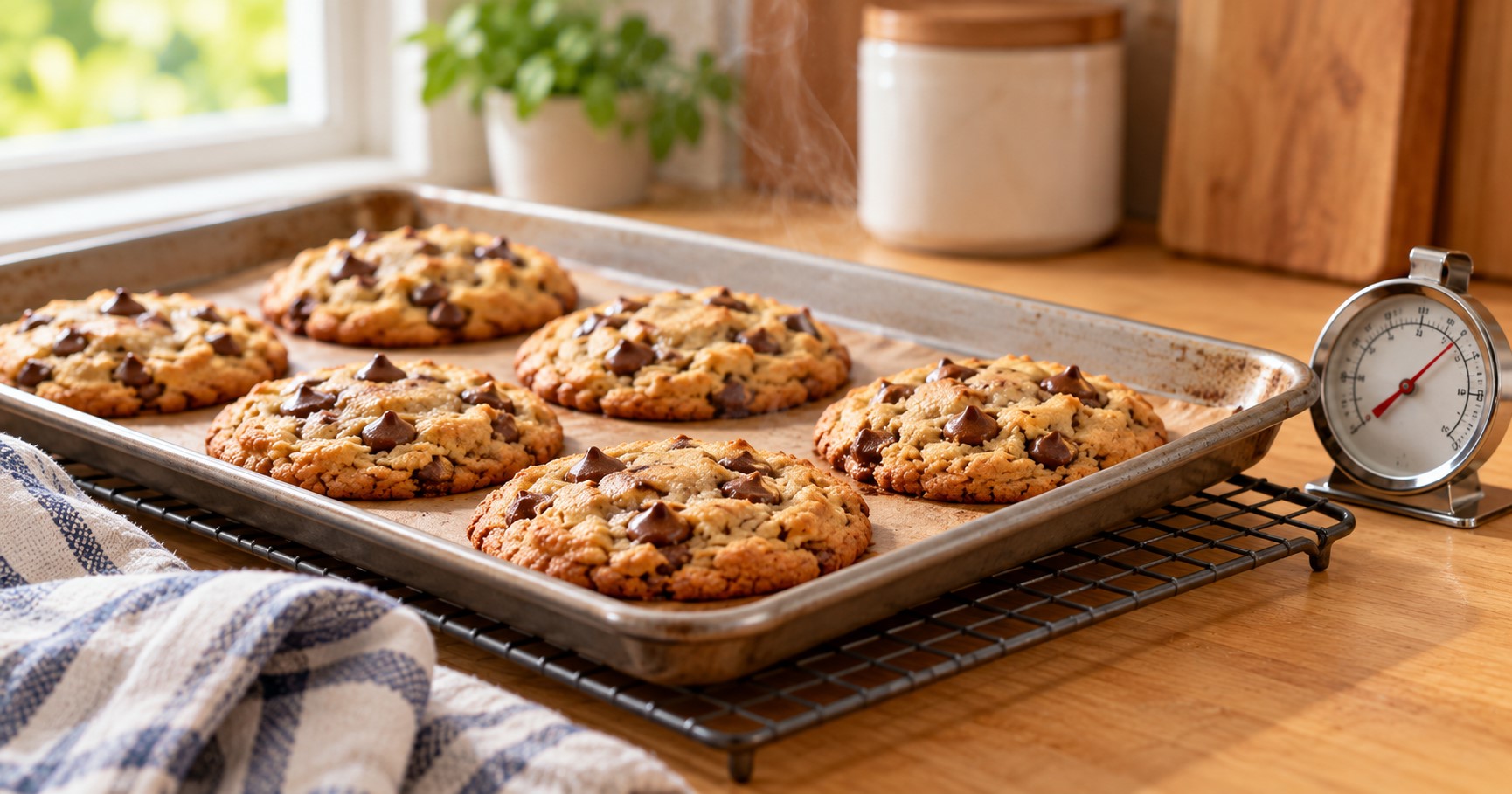
Cookie baking temperature and time are the two numbers every recipe gives you, and also the two that most often go wrong. Ovens run hot or cold, pans change how fast cookies brown, and a minute either way can turn soft cookies into hard ones.
This guide explains how cookie baking temperature and time really work, what changes them, how to find the right bake time in your own oven, and how to read the cookie instead of just the clock.
The Short Version
- Follow the recipe’s cookie baking temperature and time, but check your oven with a separate thermometer.
- Use the time as a guide. Pans, parchment, and dough size all change it.
- Do a test bake with two dough balls before you bake the whole tray.
- Take cookies out when they look done, with set edges and soft centers.
What Is the Best Cookie Baking Temperature?
There is no single best temperature for every cookie, so the safest choice is the temperature in your recipe. Most drop cookie recipes fall somewhere in the 350°F to 375°F range, though this is a general pattern and not a rule. King Arthur Baking’s browned cookie test, for example, was baked at 375°F.
Lower temperatures give a gentler bake, which tends to suit soft, thick cookies. Higher temperatures set the edges faster and brown the cookie more. If your recipe has been tested at a certain temperature, stay with it first, and change it only after you know how your oven behaves.
Why Your Oven Temperature May Be Wrong
The number on the dial is not always the real temperature inside. King Arthur’s recipe success guide advises you to preheat your oven fully, and says that built-in oven thermometers are not reliable during preheating, so you should use an independent oven thermometer to tell when it is ready.
In the same way, King Arthur’s author notes that she has never met an oven that was fully up to temperature when it signaled it was ready, so she gives it at least 10 more minutes after preheating. A cheap oven thermometer hanging on the rack is one of the best tools you can buy for baking.
What Changes Cookie Bake Time?
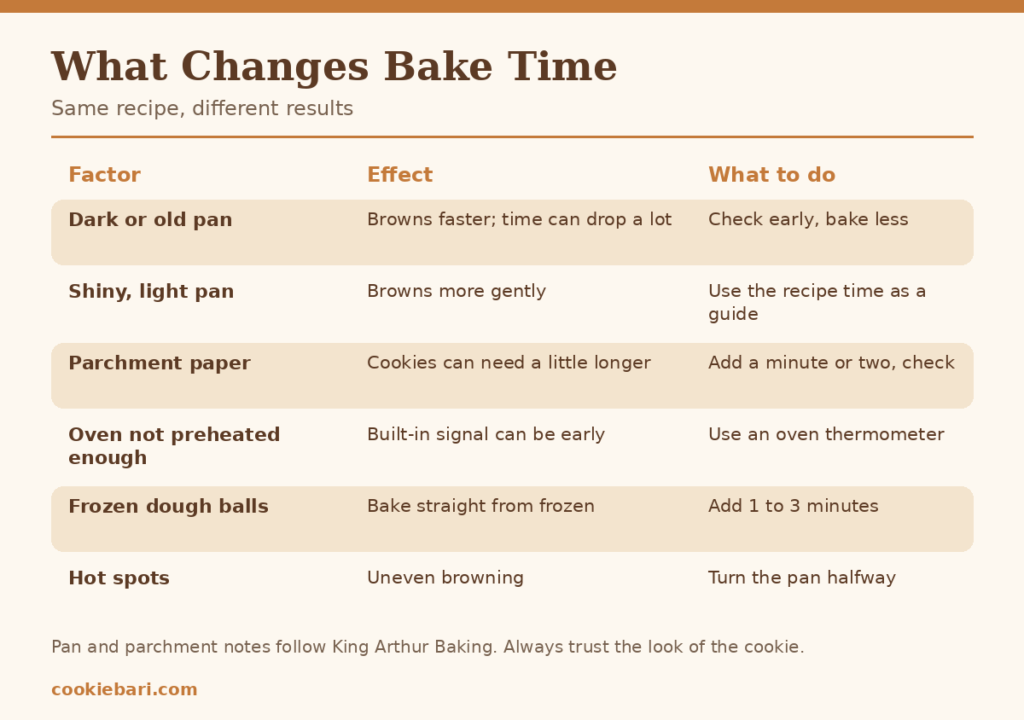
- The pan. In King Arthur’s test of browned cookies, a dark, old aluminum pan browned cookies much more than a shiny pan, and could cut the bake time by about half compared with the recipe’s pan. Learn how your own pans behave.
- Parchment paper. In the same test, cookies baked on parchment generally needed longer than cookies on a greased pan. One example was 11 minutes without parchment and 13 with it.
- Dough temperature. Cold dough takes a little longer than room-temperature dough. Cookies baked from frozen dough usually need an extra one to three minutes. See our guide on how to freeze cookie dough.
- Cookie size. Bigger cookies need more time and smaller ones need less. This is basic baking logic, so check the cookies early if you change the scoop size.
- Hot spots. Many ovens bake unevenly. King Arthur’s guide suggests reversing pans halfway through, and rotating them if you use two racks.
Where to Put the Rack
King Arthur’s guide says to place racks in the two middle positions unless the recipe says otherwise. For a single tray of cookies, the center of the oven is the usual choice, because the top and bottom heat elements affect browning more.
If you bake two trays at once, switch their positions and turn them around halfway through the bake time. That way both trays brown evenly.
The Test Bake Method
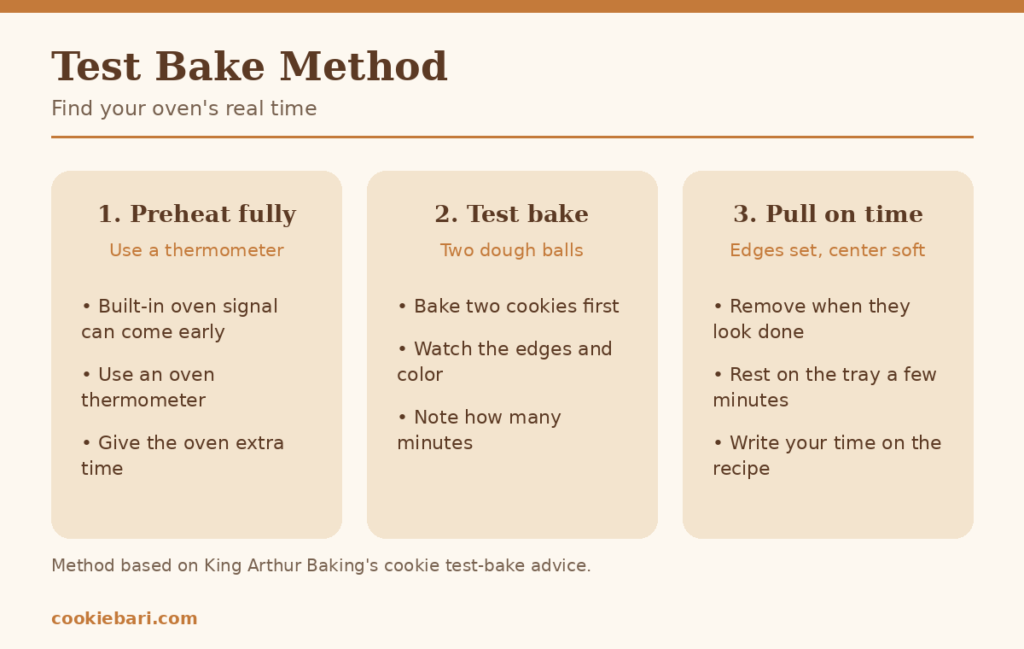
King Arthur recommends a test bake before you commit to a whole tray. Here is a simple way to do it.
- Preheat the oven fully, and check it with an oven thermometer.
- Bake just two dough balls on a lined or greased pan.
- Watch the edges and the color, and take them out when they look done.
- Write the minutes down on your recipe, so you know your own bake time next time.
This one small step saves a whole tray of cookies and teaches you how your oven and pans really behave.
How to Tell When Cookies Are Done
The clock is only a guide, so look at the cookie. For most drop cookies, these signs work well:
- Edges: They look set and lightly golden.
- Centers: They still look a little soft or slightly underdone. Cookies finish baking on the hot tray after you take them out.
- Surface: It has lost its wet shine, but is not dry or cracked all over.
Cookies that bake until they look completely firm in the oven often turn hard once they cool. Our guide on why cookies turn out hard or dry explains how overbaking and other causes affect texture.
Soft, Chewy, or Crisp: Adjusting the Bake
- Soft and chewy: Pull the cookies as soon as the edges are set and the centers still look soft.
- Crisp: Bake a little longer, until the whole cookie is golden. Crisp cookies also spread more, so see why cookies spread too much if they come out flat.
- Thick: Chill the dough first. Our guide to chilling cookie dough shows how a rest helps cookies hold their shape.
These adjustments are general baking habits, so apply them in small steps, one batch at a time.
Common Baking Mistakes
Most problems with cookie baking temperature and time come down to a few small habits:
- Trusting the oven’s beep. The oven may not be fully hot yet.
- Using a warm pan. Putting dough on a hot tray makes it spread before it bakes. Let the pan cool between batches.
- Baking by time alone. Pans and ovens vary, so check the cookies a minute or two early.
- Opening the door too often. Each time you open it, heat escapes, and the cookies bake less evenly.
- Crowding the tray. Leave space between dough balls so heat can move around them.
Cookie Recipes to Practice On
- Classic chocolate chip cookies
- Quick chocolate chip cookies
- Easy oatmeal raisin cookies
- Classic peanut butter cookies
Follow each recipe’s own temperature and time, and use the test bake method to learn how your oven handles it.
Frequently Asked Questions
What temperature should I bake cookies at?
Use the temperature in your recipe. Many drop cookies are baked between about 350°F and 375°F, but the right number depends on the dough.
How long do cookies take to bake?
Cookie baking temperature and time depend on the recipe, the pan, and the cookie size. Treat the recipe time as a guide, and check the cookies a minute or two early.
Why do my cookies burn on the bottom?
A dark or thin pan can brown the bottoms faster, and King Arthur found that dark pans can cut bake time a lot. Try a lighter, heavier pan and a middle rack, and check early.
Do I need an oven thermometer?
It helps a great deal. Built-in oven signals can be unreliable during preheating, so a separate thermometer shows when the oven is truly ready.
Should I use parchment paper?
It is a good choice for easy cleanup. Cookies on parchment can take a little longer to bake, so check them as you learn your oven.
Should I bake cookies on the middle rack?
Yes, unless the recipe says otherwise. King Arthur advises using the two middle positions, and reversing the pans halfway through the bake.
Why are my cookies raw in the middle but brown outside?
The oven may be too hot, so the outside sets before the center cooks. Check the oven with a thermometer and try a slightly lower temperature.
Final Thoughts
Good cookie baking temperature and time come down to knowing your oven. Preheat fully, use a thermometer, bake two test cookies, and take the tray out when the edges are set and the centers still look soft. Write down what works, and your cookies will be more consistent every time.