

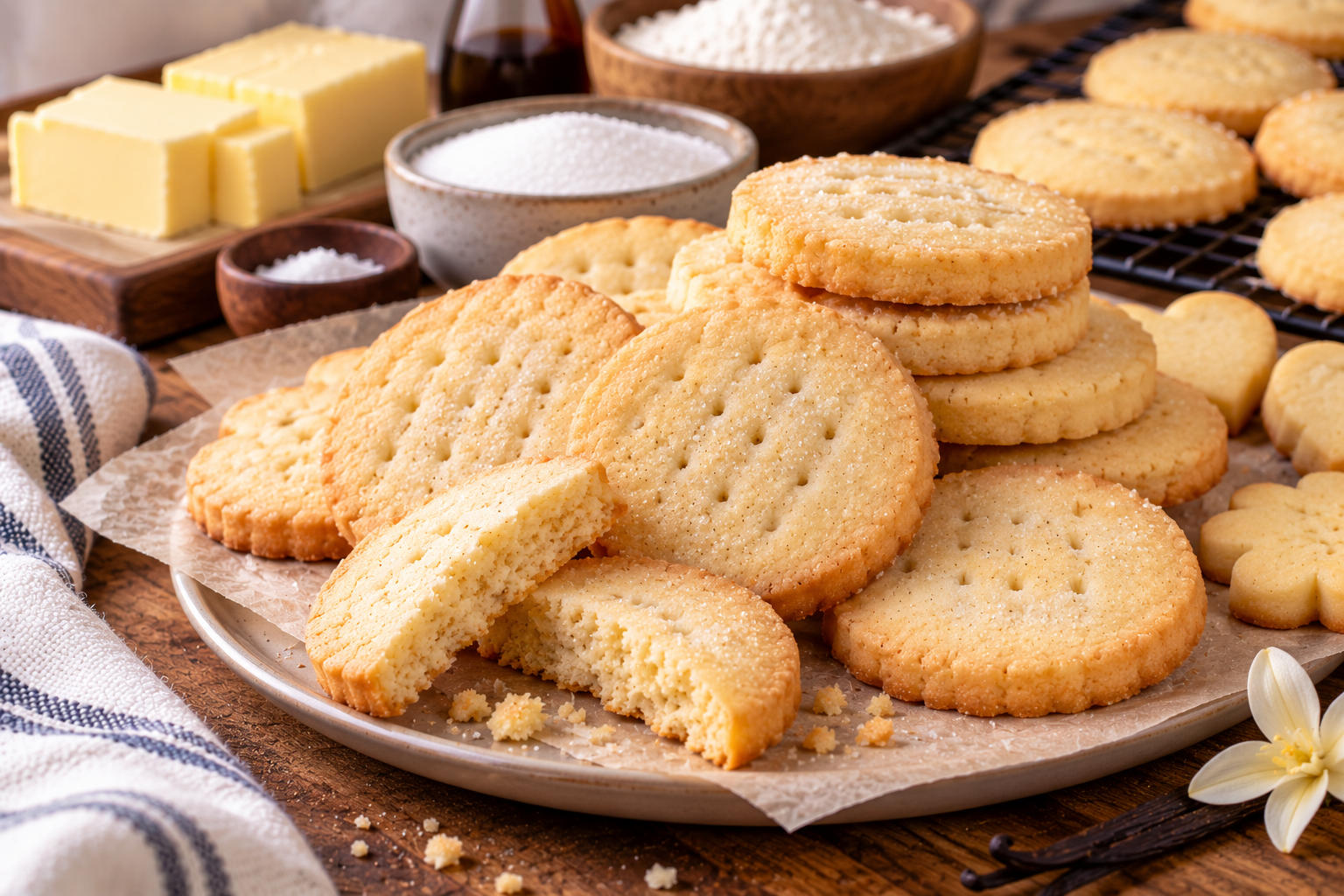
If you want the most flavor for the least effort, shortbread is hard to beat. It needs only three main ingredients, with no eggs and no leavening, yet it delivers a rich buttery taste and a delicate, crumbly bite that melts on the tongue.
This recipe covers how to make buttery, melt-in-the-mouth shortbread cookies, including what the dough should look like, how to keep the cookies tender, and a few easy flavor variations once you have the base down.
What Makes Shortbread Cookies Different?
Most cookies rely on eggs and a leavening agent to rise. Shortbread doesn’t. Its character comes from butter, sugar, and flour alone, so the quality and balance of those three matter far more than in a busier recipe. With little or no leavening, the cookies barely rise and hold whatever shape you give them before baking, which makes them ideal for cut-outs. The result is a dense but delicate cookie with a crumbly texture and a pure buttery flavor. If you enjoy simple, butter-forward bakes, our Amish sugar cookies have some of the same charm.
Recipe at a Glance
- Prep time: 15 minutes
- Chill time: 30 minutes
- Bake time: 12–16 minutes at 325°F (165°C)
- Total time: about 1 hour
- Yield: about 24 cookies, about ¼ inch thick
Ingredients
This recipe makes about 24 cookies. With so few ingredients, each one matters.
- 1 cup (226 g) unsalted butter, softened
- ½ cup (100 g) granulated sugar
- 2 cups (250 g) all-purpose flour (or swap 2 tablespoons for cornstarch)
- ¼ teaspoon salt
- 1 teaspoon vanilla extract
Why Each Ingredient Matters
- Butter: it carries almost all the flavor and creates the tender, short crumb. Unsalted butter lets you control the salt. It should be soft enough to dent with a finger but never oily.
- Granulated sugar: it adds sweetness and a subtle crispness. Shortbread uses less sugar than most cookies, which keeps the flavor buttery rather than sweet.
- All-purpose flour: it provides structure and the signature crumbly bite. Too much flour is the fastest route to dry, dense cookies. King Arthur Baking explains how to measure flour.
- Salt: it sharpens the flavor and balances the richness so the butter doesn’t taste flat.
- Vanilla: it’s optional but rounds out the buttery flavor.
For a finer, more traditional melt-in-the-mouth texture, swap 2 tablespoons of the flour for cornstarch, which softens the crumb by reducing gluten. Optional add-ins include citrus zest, finely chopped nuts, mini chocolate chips, or melted chocolate for dipping.
Choosing and Softening the Butter
Since butter does most of the work, choose one with a clean, pleasant flavor and keep it away from strong-smelling foods in the fridge, because shortbread has nowhere to hide an off taste. Take the butter out about an hour before baking. It’s ready when a gentle press leaves a dent without smearing or looking greasy. If it turns oily, return it to the fridge for ten minutes, because butter that’s too warm makes a slack dough that spreads.
Equipment You’ll Need
- Kitchen scale, for accurate flour
- Hand or stand mixer (or a wooden spoon)
- Rolling pin and cookie cutters, for cut-outs (optional)
- Parchment paper, for lining and for wrapping slice-and-bake logs
- Light-colored baking sheets, since dark pans brown the bottoms too fast
- Wire cooling rack
How to Make Buttery Shortbread Cookies
1. Preheat Low and Slow
Heat the oven to 325°F (165°C) and line your sheets with parchment. Shortbread bakes at a lower temperature than most cookies so it cooks through evenly and stays pale gold instead of browning.
2. Cream the Butter and Sugar Briefly
Beat the softened butter and sugar for just 1 to 2 minutes, until smooth and combined. You aren’t trying to make it fluffy, because too much air gives shortbread a cakey texture.
3. Stir in the Vanilla
Mix in the vanilla until incorporated.
4. Mix in the Flour and Salt
Gradually mix in the flour and salt on low speed, only until a soft dough forms. The dough looks sandy and crumbly at first, then comes together when you press a handful. Stop as soon as it holds together.
5. Shape and Chill
Shape the dough using one of the three methods below, then refrigerate for about 30 minutes to firm the butter and hold the edges.
6. Bake and Rest
Bake for 12 to 16 minutes, until the edges are barely golden and the tops still look pale. They seem slightly underdone, which is the right cue. Let them rest on the sheet for a few minutes, then move them to a rack.
Three Easy Ways to Shape the Dough
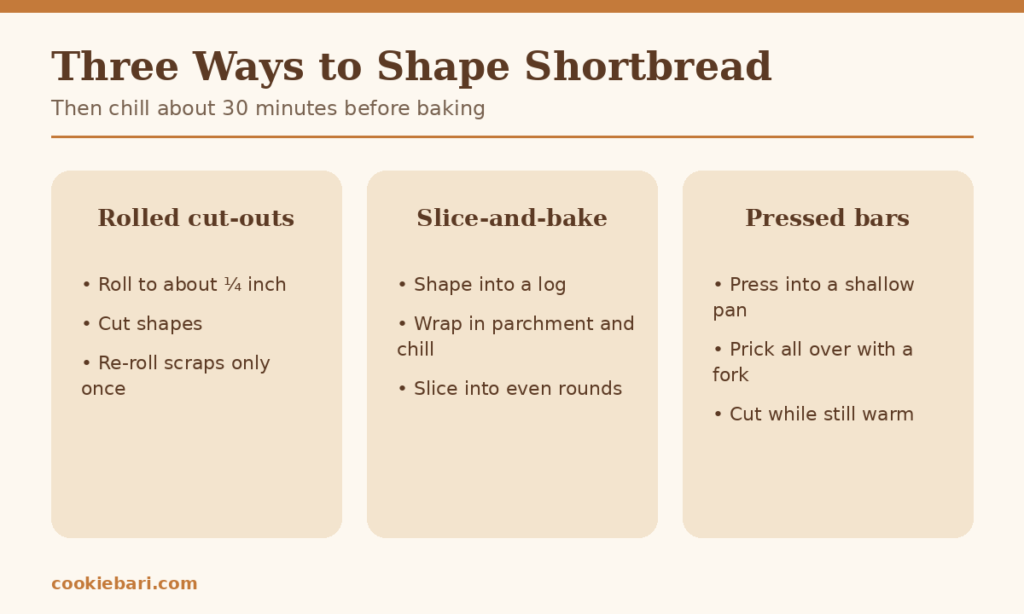
Rolled (Cut-Out)
Roll the dough on a lightly floured surface to about ¼ inch thick, cut shapes, and move them carefully to the sheet. Gather the scraps, press them together, and chill briefly before re-rolling once. Scraps warm up and toughen quickly, so re-roll only a single time and bake any leftover bits as a snack.
Slice-and-Bake
Shape the dough into a log, wrap it in parchment, and chill until firm. Slice into even rounds and arrange them on the sheet. This skips the rolling pin entirely, and the log keeps in the fridge for a couple of days.
Pressed (Bars)
Press the dough evenly into a shallow pan, smooth the top, and prick it all over with a fork. Bake the whole slab, then cut it into bars or wedges while still warm.
The Baking Science: Why These Steps Work
- Why you cream only briefly: a quick mix dissolves the sugar into the butter without whipping in much air. Shortbread has no leavening, so extra trapped air works against its dense, tender character.
- Why you handle the dough as little as possible: flour forms gluten when worked. A little gives structure, but overmixing makes shortbread tough instead of crumbly.
- Why chilling matters: cold butter melts more slowly in the oven, which keeps the cookies from spreading and helps cut-outs hold crisp edges.
- Why the low oven: a gentle 325°F cooks the interior before the outside over-browns. With so much butter and so little sugar, deep browning turns shortbread bitter and hard rather than golden and delicate.
How to Get Melt-in-the-Mouth Shortbread
The tender, sandy crumb comes down to restraint. Mix only until the dough gathers, weigh your flour, and pull the cookies while they’re still pale. The cornstarch swap softens the bite further. Gentle handling and an accurate scale do more here than any fancy technique.
Common Shortbread Cookie Mistakes
- Melted or oily butter: it makes a slack dough that spreads into greasy cookies.
- Too much flour: it’s the top cause of dry, dense shortbread. Weigh it for consistency.
- Overmixing: it develops gluten and toughens the crumb.
- Skipping the chill: warm dough loses its shape in the oven.
- Overbaking: shortbread should stay pale with lightly golden edges, never dark brown.
- A hot baking sheet: a second batch spreads more on a warm pan, so let it cool between batches.
Easy Shortbread Cookie Variations
- Citrus: beat in a teaspoon of lemon or orange zest. Orange pairs well with chocolate for the holidays.
- Chocolate-dipped: once the cookies are fully cool, dip one end in melted chocolate and set on parchment.
- Nutty: fold in finely chopped almonds, pecans, or walnuts.
- Spiced: a little cinnamon, cardamom, ginger, or nutmeg makes them warm and aromatic.
- Floral: for something special, try our lavender shortbread cookies, which use a similar base.
How to Store Shortbread Cookies
Cool the cookies completely, then keep them in an airtight container at room temperature, with parchment between layers if you stack them. Sealed well, they stay good for several days, and the container protects their delicate texture from moisture and fridge odors. Never box them up warm, because trapped steam softens the crisp edge.
Can You Freeze Shortbread?
Yes. Freeze baked cookies in a sealed container with parchment between layers, or freeze the raw dough as a wrapped disc or log and thaw it in the fridge before rolling or slicing. A dough log in the freezer means fresh shortbread whenever you want it.
Food safety: Shortbread dough contains raw flour, so don’t eat it before baking. The FDA explains the risks of raw flour.
Frequently Asked Questions
Why is my shortbread crumbly?
Some crumbliness is normal, since that’s the texture. Excessive crumbling usually means too much flour or butter that was too cold to bind the dough. Measuring by weight fixes it most of the time.
Why did my shortbread spread?
The dough was probably too warm or the butter too soft. Chilling the shaped cookies before baking, and using a cool baking sheet, keeps them in shape.
Can I make shortbread without a mixer?
Yes. Because you only cream briefly, a wooden spoon works fine. Just soften the butter well first so it combines easily.
Can I use powdered sugar instead of granulated?
Yes, and many bakers prefer it. Powdered sugar dissolves more finely and gives a more tender crumb, though the edges will be slightly less crisp. Use the same weight of sugar.
Can I freeze shortbread cookie dough?
Yes. Wrap the shaped disc or log tightly and freeze it, then thaw in the fridge before rolling or slicing.
Can I use salted butter?
Yes, but reduce or omit the added salt so the cookies don’t turn out too salty.
Final Thoughts
Shortbread shows that a short ingredient list can still make something special. The details that matter are soft but not oily butter, accurately weighed flour, a gentle hand with the dough, and a low oven that keeps the cookies pale and delicate. Once you know the base, citrus, chocolate, nut, and spiced versions are easy to try for every season.+