

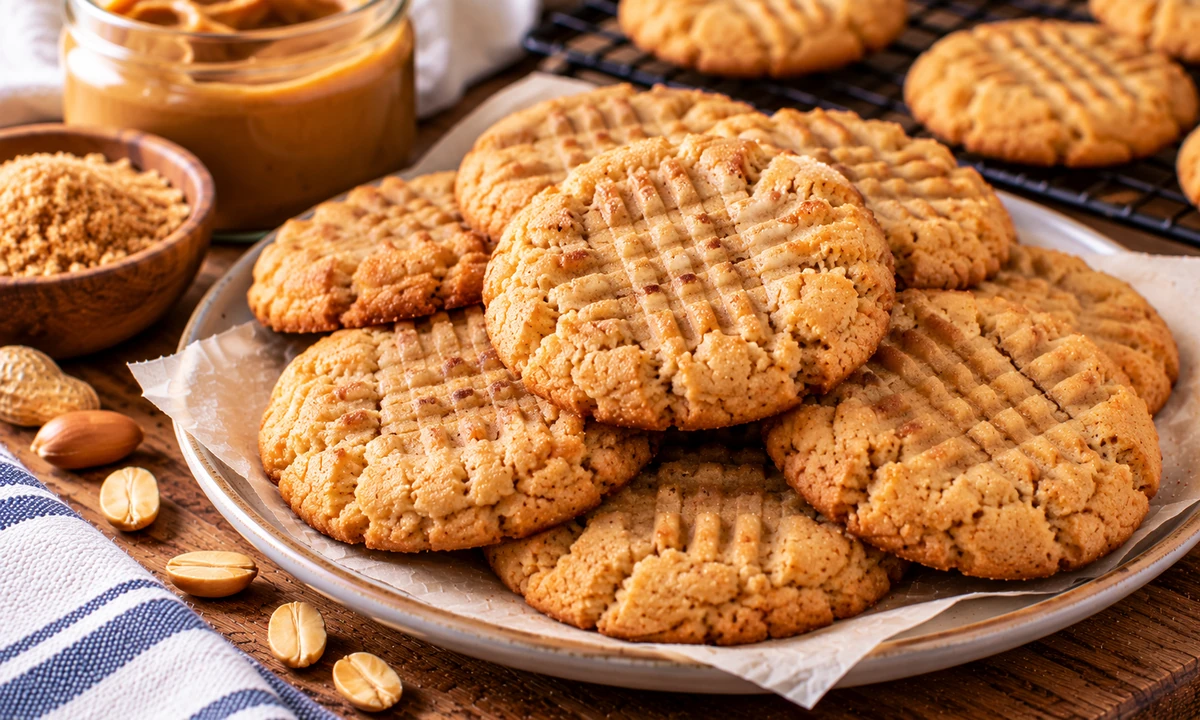
Few homemade cookies combine richness, sweetness, and nutty flavor like classic peanut butter cookies. The edges are slightly crisp and the centers stay soft. They suit family gatherings, afternoon snacks, holiday baking, and everyday desserts, and they use simple ingredients already in most kitchens.
A great batch comes down to balance. The cookie should be sturdy enough to hold its shape yet tender enough to melt in your mouth, with peanut butter as the star and a touch of vanilla and salt rounding things out. There’s no complicated technique, and the dough comes together quickly.
Recipe at a Glance
- Yield: about 24 medium cookies
- Chill time: optional, about 20–30 minutes if the dough is soft
- Bake time: 9–12 minutes at 350°F (175°C)
- Rest time: 5 minutes on the baking sheet
Why Classic Peanut Butter Cookies Are So Popular
These cookies have stayed popular for generations because they turn pantry staples into something flavorful without fuss. Peanut butter brings a rich, slightly salty note that pairs naturally with sugar and butter.
They’re also easy to adapt. Some people like them soft and thick, others prefer a crispier bite, and chocolate chips, chopped peanuts, or a sugar coating each push the result in a new direction.
The fork-pressed design makes them recognizable at a glance. Pressing flattens each cookie slightly, which helps it bake evenly and creates the classic crisscross pattern.
Ingredients
- ½ cup (113 g) unsalted butter, softened
- ¾ cup (190 g) creamy peanut butter
- ½ cup (100 g) granulated sugar
- ½ cup (110 g) packed brown sugar
- 1 large egg
- 1 teaspoon vanilla extract
- 1½ cups (190 g) all-purpose flour
- ½ teaspoon baking soda
- ½ teaspoon baking powder
- ½ teaspoon salt
For a decorative touch, roll the dough balls in granulated sugar before pressing them with a fork.
Creamy peanut butter gives the smoothest, most predictable dough. Natural peanut butter works too, as long as you stir it thoroughly first, since the oil separates.
Allergy note: peanuts are a major food allergen. If you’re baking for a group, keep these cookies apart from nut-free baked goods to avoid cross-contact. The FDA explains major food allergens and labeling.
How to Make Classic Peanut Butter Cookies
1. Prepare the Oven
Heat the oven to 350°F (175°C) and line one or two baking sheets with parchment paper. Without parchment, a light grease works too. Let the oven reach full temperature before baking, since steady heat gives even spreading and browning.
2. Cream the Butter, Peanut Butter, and Sugars
In a large bowl, beat the softened butter, peanut butter, granulated sugar, and brown sugar until smooth and well combined. Use softened butter, not melted, because melted butter loosens the dough and makes the cookies spread more than you’d like.
3. Mix in the Egg and Vanilla
Beat in the egg and vanilla until fully incorporated, scraping down the sides and bottom of the bowl. The dough should look smooth and creamy.
4. Combine the Dry Ingredients
In a separate bowl, whisk together the flour, baking soda, baking powder, and salt. Mixing them separately spreads the leavening and salt evenly, so no single cookie gets more baking soda than the rest.
5. Mix the Dough
Gradually stir the dry ingredients into the peanut butter mixture, just until a soft dough forms. Overmixing develops gluten, which makes cookies tough instead of tender. The dough should be soft but firm enough to shape by hand. If it’s unusually sticky, 20–30 minutes in the refrigerator makes it easier to work with.
How to Shape and Bake
Use a tablespoon or cookie scoop to divide the dough into portions of about 2 tablespoons (roughly 30 g) each. Roll each into a smooth ball. Rolling the balls lightly in granulated sugar adds a light crunch and a bit of sparkle. Space them about 2 inches apart, since they spread as they bake.
Press each ball with a fork twice, once in each direction, for the traditional crisscross pattern. Besides the look, this flattens the cookies to an even thickness so they bake consistently.
Chilling isn’t required, but it helps if the dough feels too soft to shape cleanly, or if you want slightly thicker cookies, because 30 minutes in the refrigerator firms the butter and reduces spreading. If the dough gets too hard to roll, let it sit out briefly.
Bake at 350°F (175°C) for 9 to 12 minutes. The edges should be lightly golden while the centers still look a bit soft. Don’t wait for the whole cookie to firm up in the oven, because it keeps setting on the hot pan. Pull the cookies earlier in that range for a softer result, later for a firmer, slightly crispier one. Let them rest on the baking sheet for about 5 minutes before moving them to a wire rack.
Getting the Texture Right: Soft vs. Crispy
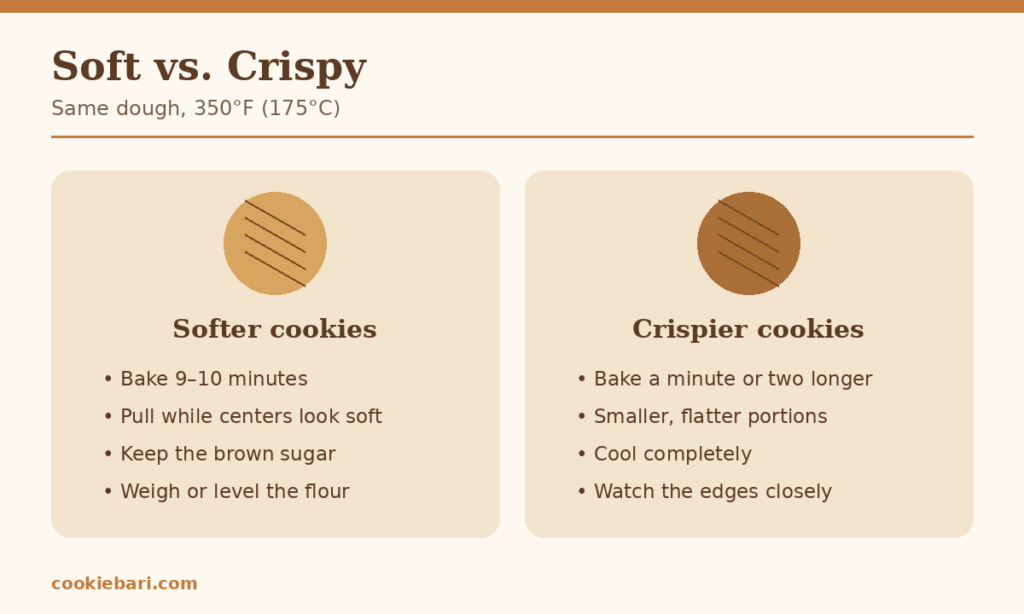
For soft cookies, don’t overbake; the centers should stay a little underdone when they come out. Brown sugar helps, since its moisture keeps the texture tender, and pairing it with granulated sugar gives both chew and structure. Flour measurement matters too, because too much makes a dry, dense cookie. Weigh it if you can, or spoon it into the cup rather than scooping from the bag. King Arthur Baking explains how to measure flour in detail.
For a crispier cookie, do the opposite: bake a minute or two longer and let the cookies cool completely before eating. Slightly smaller, flatter portions also crisp faster. Watch them near the end, though, because peanut butter cookies can go from golden to overly dark quickly.
Choosing the Right Peanut Butter
The peanut butter you use shapes the texture more than people expect.
- Conventional creamy peanut butter gives predictable results. It’s formulated to stay blended, so there’s no separation to manage.
- Natural peanut butter works, but the oil rises to the top of the jar. If you don’t stir it thoroughly before measuring, the dough can end up greasy in some spots and dry in others.
- Crunchy peanut butter is a direct swap if you want small peanut pieces through the cookies. No other changes are needed.
Peanut Butter Cookie Variations
- Chocolate chip: fold in semisweet chips for contrast against the peanut butter. For a chocolate chip cookie without peanut butter, try our classic chocolate chip cookie recipe.
- Chocolate-dipped: once the cookies are cool, dip one side in melted chocolate and let it set.
- Peanut butter and jelly: press a small indentation into each dough ball and fill it with fruit preserves before baking.
- Crunchy: use crunchy peanut butter for extra texture.
- Oatmeal: fold in rolled oats for a heartier, chewier cookie, and reduce the flour slightly if you add a lot. Our soft and chewy oatmeal cookies are a good reference for oat ratios.
- Dairy-free: replacing the butter in this recipe isn’t a tested swap. For a dairy-free cookie, try our soft and chewy dairy-free chocolate chip cookies.
Common Mistakes to Avoid
- Too much flour: the most common reason these cookies turn out dry and dense. Measure carefully.
- Melted butter: it loosens the dough and causes excess spreading.
- Overmixing: once the flour goes in, mix only until combined.
- Skipping the fork pattern: it’s not just decoration. Pressing flattens the dough so it bakes more evenly.
- Waiting for a fully firm center: this is the fastest route to overbaked, dry cookies. Soft centers firm up as they cool.
How to Store and Freeze
Let the cookies cool completely, then keep them in an airtight container at room temperature for up to about a week. Store them apart from strongly flavored cookies so the aromas don’t transfer.
Both baked cookies and unbaked dough freeze well. For baked cookies, cool completely, then freeze in an airtight, freezer-safe container with parchment between layers. For dough, shape it into balls, freeze them on a tray until firm, then move them to a freezer-safe bag. Frozen dough portions can go straight into the oven, with a few extra minutes of baking.
Food safety: This dough contains raw egg and raw flour, so treat it as bake-only. The FDA explains the risks of raw flour, and the CDC explains why you shouldn’t eat raw dough.
Tips for Perfect Peanut Butter Cookies
- Use softened butter, not melted.
- Stir natural peanut butter thoroughly before measuring.
- Measure the flour accurately.
- Avoid overmixing once the flour goes in.
- Chill the dough only if it feels too soft to shape.
- Keep the portions evenly sized and leave space between them.
- Use the fork pattern for even baking, not just looks.
- Pull the cookies while the centers are still soft, and cool them before storing.
Frequently Asked Questions
Why are my peanut butter cookies dry?
Usually too much flour or too much time in the oven. Measure carefully and pull the cookies while the centers still look soft.
Why did my cookies spread too much?
Warm butter, overly soft dough, or a hot baking sheet are the usual causes. Chilling the dough beforehand helps.
Can I use crunchy peanut butter?
Yes. It swaps directly for creamy and adds small peanut pieces throughout.
Do I have to make the crisscross pattern?
Not strictly, but some flattening helps the cookies bake evenly, so it’s worth doing in some form.
Can I use natural peanut butter?
Yes, as long as the oil is fully stirred back in before measuring. Uneven oil throws off the dough’s consistency.
How can I make these cookies softer?
Keep the brown sugar, don’t overbake, and chill the dough if you want a thicker cookie. Store the cooled cookies in an airtight container.
Serving Suggestions
These cookies are great at room temperature, and a few minutes warm out of the oven doesn’t hurt. Pair them with milk, coffee, or tea, or serve one warm with vanilla ice cream. They travel well for lunchboxes, picnics, and bake sales because they’re sturdy and easy to portion. For a dressier finish, add melted chocolate, sprinkles, or a dusting of powdered sugar.
Final Thoughts
Classic peanut butter cookies show that a short ingredient list can still be very satisfying. The details that matter most are properly softened butter, accurate flour measurement, gentle mixing, and pulling the cookies before the centers fully firm up. A short chill fixes dough that’s too soft. Once the base recipe feels familiar, chocolate chips, jam, oats, or a chocolate dip all work without losing the peanut butter flavor at the center.