

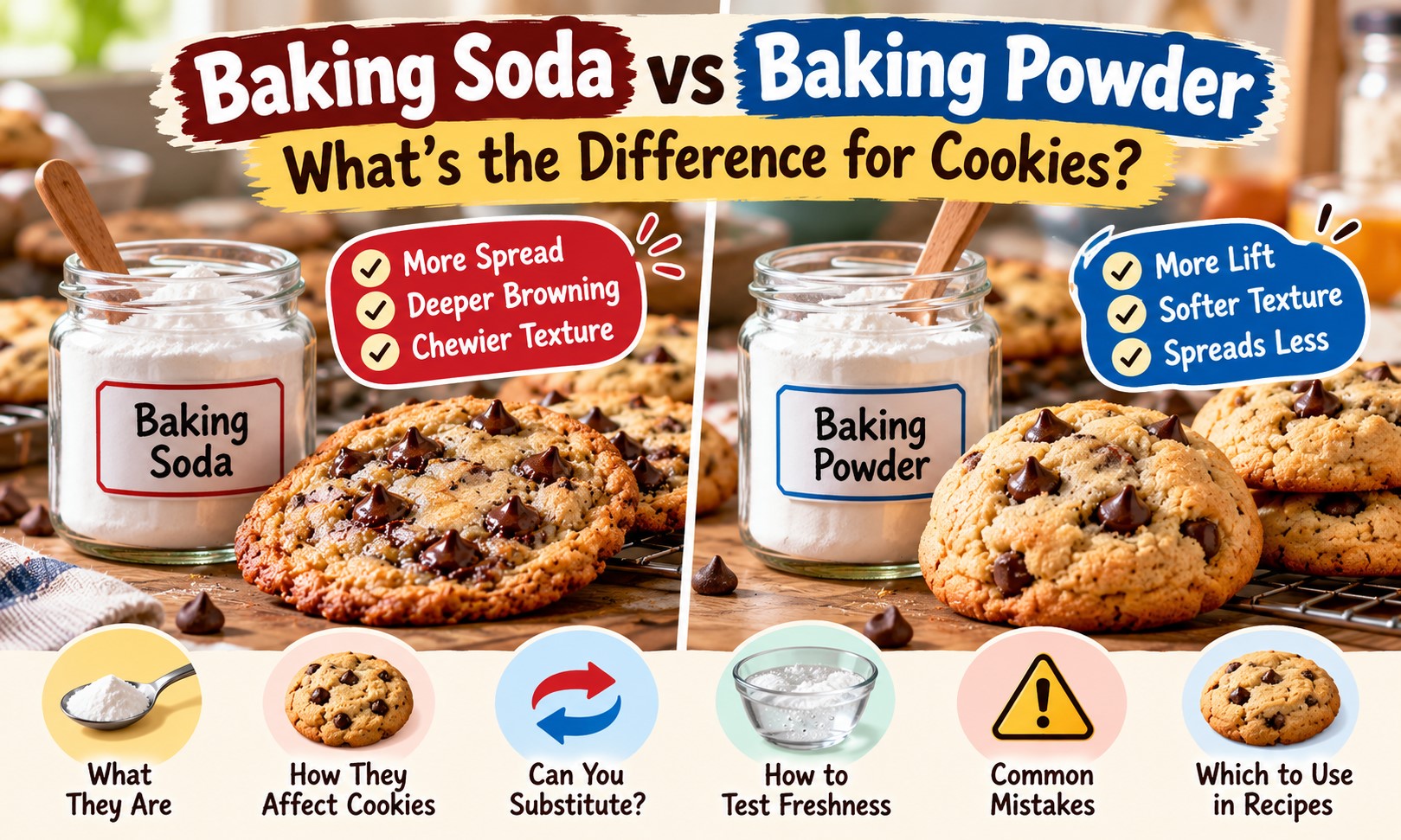
Baking soda vs baking powder is one of the most common questions in cookie baking, because the two look almost identical and sit side by side on the shelf. They are not interchangeable, and using the wrong one can change how your cookies spread, rise, brown, and taste.
This guide explains what each one does, how baking soda vs baking powder affects cookies, how to test whether yours is still fresh, and what to do if a recipe calls for one and you only have the other.
The Short Version
- Baking soda needs an acid in the dough to work. It helps cookies spread and brown.
- Baking powder already contains its own acid. It gives cookies more lift and a softer, cakier texture.
- Many cookie recipes use baking soda alone. Some use both, and some use only baking powder.
Baking Soda vs Baking Powder: Side by Side
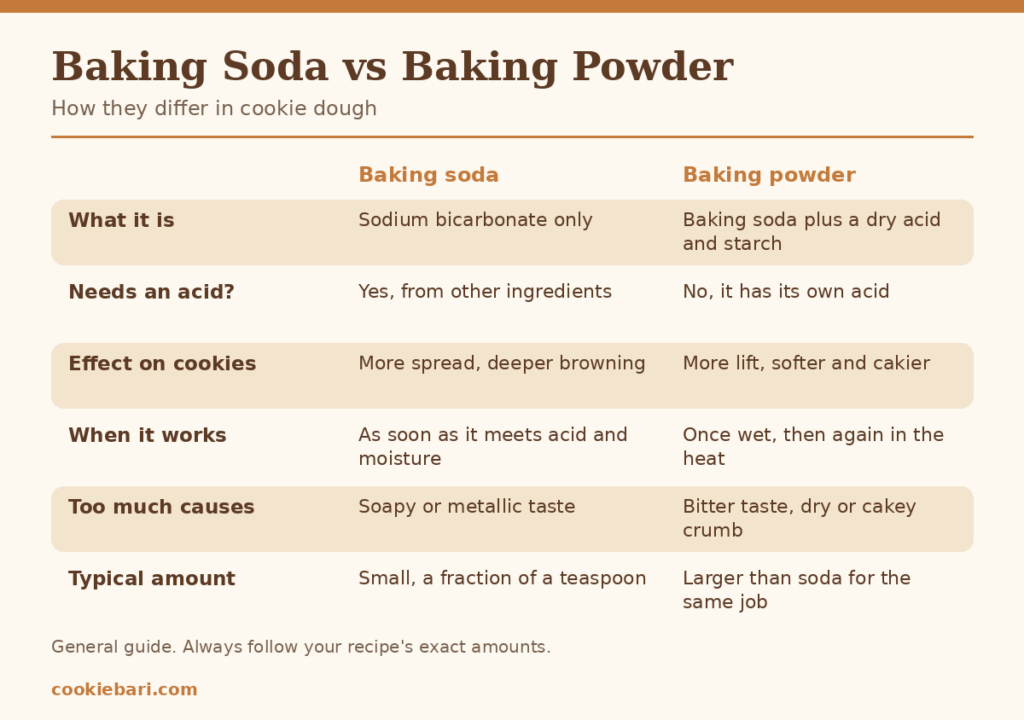
| Baking soda | Baking powder | |
|---|---|---|
| What it is | Sodium bicarbonate only | Baking soda plus a dry acid and a starch |
| Needs an acid? | Yes, from other ingredients in the dough | No, it contains its own acid |
| Effect on cookies | More spread and deeper browning | More lift, softer and cakier |
| When it starts working | Soon after it meets acid and moisture | When mixed with liquid, then again in the oven’s heat |
| Too much causes | Soapy or metallic taste | Bitter taste and a dry or cakey crumb |
What Is Baking Soda?
Baking soda is pure sodium bicarbonate. When it meets an acid and moisture, it releases carbon dioxide gas, which makes the dough rise and become lighter. Baking soda is also alkaline, which helps cookies brown more deeply and spread out.
Because baking soda needs an acid to react, recipes that use it usually include an acidic ingredient. Common ones in cookie dough are:
- Brown sugar and molasses
- Honey
- Buttermilk, yogurt, or sour cream
- Natural cocoa powder
- Lemon juice or vinegar
For this reason, brown sugar cookies, like chocolate chip cookies, work so well with baking soda.
What Is Baking Powder?
Baking powder is a mix of baking soda, a dry acid (such as cream of tartar), and a starch that keeps it dry. Because the acid is already included, it only needs moisture and heat to work.
Most baking powder sold today is double-acting. It reacts a little when it gets wet and again when it heats in the oven. That gives cookies a steadier rise and a softer, more cake-like crumb with less spread.
How Baking Soda vs Baking Powder Changes Your Cookies
- Spread: Baking soda encourages spreading and crisp edges. Baking powder gives puffier cookies that spread less.
- Browning: Baking soda helps cookies turn a deeper golden brown.
- Texture: Baking powder gives a softer, cakier bite. Baking soda gives a chewier, denser cookie.
- Flavor: Too much of either can leave a metallic, soapy, or bitter aftertaste.
However, some recipes use both to balance spread and lift. The amounts are small and carefully balanced, so measure level spoonfuls.
Can You Substitute One for the Other?
Sometimes, but the results will not be identical.
- Baking powder instead of baking soda: A common rule of thumb is to use about three times as much baking powder as the baking soda in the recipe. King Arthur Baking gives the same three-to-one ratio in its guide to the difference between baking soda and baking powder, and how to substitute them. The cookies will usually be softer and puffier, with less browning, and the dough may taste slightly different.
- Baking soda instead of baking powder: This is harder, because baking soda needs an acid to work. Without one, the cookies can taste soapy and turn out flat. If you must try, King Arthur suggests a homemade baking powder: for each teaspoon of baking powder you need, mix ¼ teaspoon baking soda, ½ teaspoon cream of tartar, and ¼ teaspoon cornstarch.
Therefore, the safest option is to buy the one the recipe calls for. If you do substitute, test with a single cookie before baking the tray.
How to Test If They Are Still Fresh
Over time, old leaveners lose their power. If your cookies bake up flat or dense for no clear reason, an expired baking soda or powder is a likely suspect.
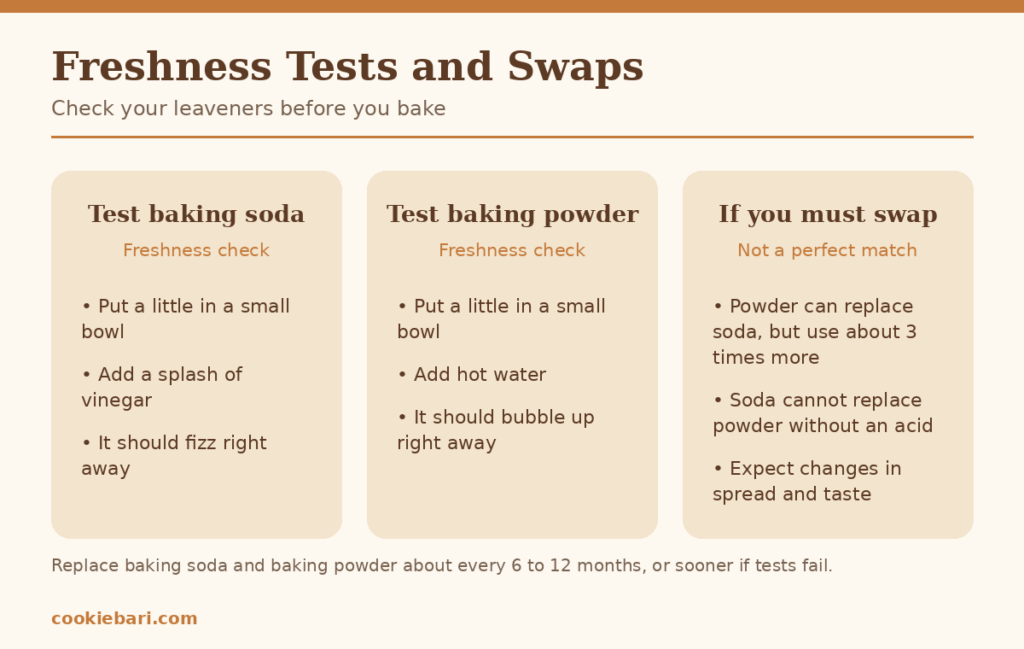
- Test baking soda: Put a small amount in a bowl and add a splash of vinegar. It should fizz right away.
- Test baking powder: Put a small amount in a bowl and add hot water. It should bubble up right away.
Also, store both in a cool, dry place with the lid closed. Replace them every six to twelve months, or sooner if the tests fail.
Common Mistakes
- Mixing them up. Check the label, and measure the right one with a clean, dry spoon.
- Using a heaping spoonful. Level every measurement. Even a small extra amount changes the taste.
- Not mixing it in evenly. Whisk the leavener with the flour so you do not get bitter pockets.
- Letting the dough sit too long with baking soda. It starts working soon after it meets moisture and acid, so bake in a reasonable time.
- Using old leavener. Test it if it has been open for a long time.
Cookie Recipes to Try
Read the leavening in each recipe and see how it changes the cookie:
- Classic chocolate chip cookies
- Thick chocolate chip cookies
- Soft and chewy oatmeal cookies
- Easy homemade sugar cookies
Frequently Asked Questions
What is the difference between baking soda and baking powder?
Baking soda is a single ingredient that needs an acid to work. Baking powder is a mix that already contains baking soda and an acid. Expect more spread and browning from soda, but more lift from powder.
Can I use baking powder instead of baking soda in cookies?
You can, using about three times as much baking powder as the recipe’s baking soda. Expect softer, puffier cookies with less browning.
Can I use baking soda instead of baking powder?
Not easily. Baking soda needs an acid. Without it, the cookies may taste soapy and turn out flat.
Why do some cookie recipes use both?
Baking soda helps with spread and browning, while baking powder adds lift. Using both balances the two effects.
Does baking soda make cookies chewy?
It helps cookies spread and brown, which often gives crisp edges and a chewy center. The final texture also depends on the sugar, butter, and baking time.
How long do baking soda and baking powder last?
They lose strength over time. Replace them every six to twelve months, and test them if you are unsure.
Why do my cookies taste metallic?
Too much baking soda or baking powder is a common cause. Level your measuring spoon and check the amount against the recipe.
Final Thoughts
The baking soda vs baking powder choice comes down to a simple idea: baking soda helps cookies spread and brown, and baking powder helps them rise and stay soft. Use what the recipe calls for, measure level spoonfuls, and test your leaveners if your cookies start behaving oddly.